
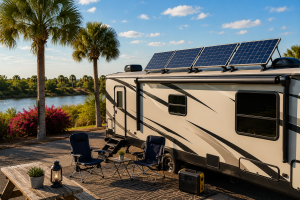
The Rio Grande Valley gets more annual sunshine than almost anywhere else in the country, which sounds like the perfect setup for RV solar — and in a lot of ways, it is. But “great solar climate” and “solar will solve your summer power problems” are two genuinely different claims, and understanding exactly where solar helps and where it doesn’t is what separates a smart investment from an expensive disappointment.
What RV Solar Is Actually Good At
Solar panels charge your RV’s house batteries using sunlight, and that stored power runs your RV’s 12-volt systems — lights, water pump, fans, phone charging, and similar lower-draw electrical needs — without requiring shore power or a generator. For RVers who spend time boondocking or dry camping without hookups, this is a genuinely valuable capability: solar keeps your basic systems running indefinitely as long as the sun keeps charging your batteries, which is exactly the freedom that draws a lot of RVers to solar in the first place.
The RGV’s climate is genuinely excellent for solar generation specifically — abundant sun exposure across most of the year means panels here produce close to their rated output on a consistent basis, more reliably than a cloudier or more northern climate would allow. If your RV use case is primarily about running lower-draw systems without hookups, the Valley’s sun exposure makes solar a strong investment.
Where Solar Runs Into Real Limits: Air Conditioning
Here’s the honest limitation that a lot of solar marketing glosses over: running an RV air conditioner off a typical solar and battery setup is genuinely difficult, and for most standard RV solar systems, simply not realistic as a sustained solution. A single rooftop AC unit typically draws somewhere in the range of 1,200 to 1,800 running watts, with a notably higher surge requirement during startup. Sustaining that draw for the many hours per day that RGV summer heat demands would require a battery bank and solar array considerably larger than what most RVers install — we’re talking a system sized more like a small off-grid cabin’s power setup than a typical RV solar kit.
The Actual Math
A common RV solar setup in the 200 to 600 watt panel range, paired with a few hundred amp-hours of battery capacity, is well-suited to lower-draw systems but isn’t going to sustain AC operation through a full RGV summer day. Even with excellent sun exposure, generating and storing enough energy to run an AC unit continuously through 90-plus-degree afternoons requires a battery bank and panel array that most RVers find impractical both in cost and in physical space on and around the rig.
“People hear ‘RGV has great sun’ and assume that means solar solves the AC problem too. It really doesn’t, not with a typical setup. Solar is fantastic for keeping your fridge, lights, and fans running without a generator. Air conditioning through a Valley summer is still mostly a shore power or generator job unless you’re willing to invest in a genuinely large, expensive system most RVers don’t need.”
Cost vs. Benefit: A Realistic Range
Solar system costs vary considerably based on panel wattage, battery capacity, and whether you’re installing a basic setup yourself or having a more complete system professionally installed. Here’s a general range for planning purposes:
| System Type | Approximate Cost Range | What It Realistically Supports |
|---|---|---|
| Basic (100-200W, small battery) | $300-800 | Lights, fans, phone charging, water pump |
| Mid-range (400-600W, larger battery bank) | $1,500-3,500 | Above, plus laptop/small electronics, occasional fridge support |
| Large system (800W+, substantial battery bank) | $4,000-8,000+ | Above, plus limited AC runtime under favorable conditions — not full-day sustained use |
These are general planning ranges, not quotes for any specific system — actual costs depend heavily on your specific components, whether you DIY the installation, and current equipment pricing. The key takeaway is that even a large, expensive system typically supports only limited AC runtime rather than the kind of continuous cooling an RGV summer actually demands.
Who Solar Genuinely Makes Sense For in the RGV
Solar is a strong investment for RVers who spend meaningful time boondocking or at sites without full hookups, since it eliminates generator noise and fuel costs for running basic systems. It’s also valuable as a supplemental power source even at a full-hookup site, reducing your draw on shore power for lower-level systems and potentially extending battery life if you experience any power interruptions. For RVers who plan to stay primarily at full-hookup sites with reliable shore power specifically to run AC through the summer, solar’s value proposition shifts from “solving your cooling problem” to “a useful supplemental system for everything except AC.”
Understanding your specific use case — how much boondocking you actually do versus how much time you spend at full-hookup sites — is the real question that should drive a solar investment decision, more than the RGV’s genuinely favorable sun exposure alone.
Solar as Part of a Broader Summer Power Strategy
For RGV summer RVing specifically, solar works best as one piece of a broader approach rather than a standalone solution. Combining solar for basic systems with a reliable shore power connection (with the correct hookup amperage for your AC needs) at your actual campsite, and reducing overall AC load through shade and reflective window coverings, gives you a genuinely comprehensive strategy rather than expecting solar alone to carry the full summer cooling burden. The how to beat the heat summer RVing guide covers the broader heat-management picture that solar fits into as one component rather than the entire solution.
Maintenance and Troubleshooting Considerations
Like any RV system, solar setups require periodic maintenance — checking panel connections, monitoring battery health, and keeping panels clean of dust, which the RGV’s dry conditions can accumulate on exposed surfaces. Having basic tools and diagnostic equipment on hand for troubleshooting electrical connections is worth considering as part of your overall RV toolkit. The best RV toolkits for on-the-road repairs guide covers the general equipment worth having on hand for this kind of electrical system maintenance and troubleshooting.
Good for: lights, fans, water pump, phone/laptop charging, fridge support, boondocking without a generator. RGV’s strong sun exposure makes solar generation genuinely reliable here.
Not realistic for: sustained AC operation through a full summer day, with a typical 200-600W system. AC draws 1,200-1,800+ running watts; sustaining that requires a system sized more like an off-grid cabin than a typical RV kit.
Cost ranges: basic setup $300-800, mid-range $1,500-3,500, large system $4,000-8,000+ (limited AC runtime only, even at this tier).
Best fit: RVers who boondock regularly, or want a supplemental system alongside shore power at full-hookup sites.
Realistic summer strategy: solar for basic systems + reliable shore power/correct amperage for AC + shade/window coverings to reduce AC load overall.
For guests planning a summer RGV stay who want to understand the full range of hookup and power options available, current rates and site information are at the Mission RV Resort pricing page. And for booking a summer stay with reliable shore power for your AC needs, Mission RV Resort is the starting point.
Frequently Asked Questions
Can RV solar panels run my air conditioner in the Rio Grande Valley?
Generally, no, not with a typical RV solar setup. A single rooftop AC unit typically draws 1,200 to 1,800 running watts with a higher startup surge, and sustaining that draw for the many hours per day that RGV summer heat demands requires a battery bank and solar array considerably larger than most RVers install — closer to a small off-grid cabin’s power system than a standard RV solar kit. Even a large, expensive RV solar system typically supports only limited AC runtime under favorable conditions rather than continuous cooling through a full summer day. Shore power or a generator remains the realistic solution for sustained AC use in RGV summer heat.
Is the Rio Grande Valley a good climate for RV solar panels?
Yes, for what solar is actually good at. The RGV receives abundant sunshine across most of the year, meaning solar panels here produce close to their rated output consistently, more reliably than a cloudier or more northern climate would allow. This makes the region genuinely well-suited to solar for lower-draw systems like lights, fans, water pumps, and phone charging, particularly for RVers who boondock or dry camp without hookups. The favorable sun exposure doesn’t change the fundamental power requirements of air conditioning, however, which remains a separate consideration from general solar suitability.
How much does an RV solar system cost?
Costs vary considerably based on system size. A basic setup (100-200 watts with a small battery) commonly runs $300 to $800 and supports lights, fans, and phone charging. A mid-range system (400-600 watts with a larger battery bank) typically runs $1,500 to $3,500 and adds capacity for laptops and occasional refrigerator support. A large system (800+ watts with a substantial battery bank) can run $4,000 to $8,000 or more, and even at this tier, typically supports only limited air conditioning runtime rather than full-day sustained use. These are general planning ranges rather than quotes for a specific system, since actual costs depend on components, installation approach, and current equipment pricing.
Who should actually get RV solar panels for a Rio Grande Valley trip?
Solar makes the most sense for RVers who spend meaningful time boondocking or staying at sites without full hookups, since it eliminates generator noise and fuel costs for running basic systems. It’s also valuable as a supplemental power source even at a full-hookup site, reducing draw on shore power for lower-level systems. For RVers planning to stay primarily at full-hookup sites specifically to run AC reliably through the summer, solar’s value shifts from solving the cooling problem to being a useful supplemental system for everything except air conditioning.
What is the best power strategy for RV camping in the RGV summer?
A comprehensive approach works better than relying on any single power source. Combining solar for basic systems (lights, fans, water pump, charging) with a reliable shore power connection matched to the correct amperage for your AC needs, and reducing overall AC load through shade and reflective window coverings, gives a realistic strategy for managing power through RGV summer heat. Expecting solar alone to carry the full cooling burden of a Valley summer, without shore power or a generator as the primary AC power source, isn’t a realistic plan with a typical RV solar setup.
Do RV solar panels require much maintenance?
RV solar systems require periodic maintenance including checking panel electrical connections, monitoring battery health, and keeping panels clean of dust, which the RGV’s dry conditions can accumulate on exposed surfaces over time. Having basic diagnostic tools on hand for troubleshooting electrical connections is a reasonable part of general RV maintenance preparedness, alongside the other tools most RVers keep for on-the-road repairs.