
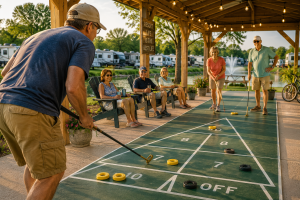
Walk past a resort shuffleboard court on any given afternoon and you’ll usually find at least a couple of people out there, cue in hand, genuinely absorbed in a game most people haven’t played since a childhood family reunion. It’s one of those games that looks simple from the sidelines and turns out to have real strategy once you actually start playing — and it’s easy enough to pick up in one afternoon.
The Basic Setup
A regulation outdoor shuffleboard court measures 52 feet long by 6 feet wide, with a triangular scoring zone at each end. Each scoring triangle is divided into sections worth different point values, and behind the triangle sits a small penalty area known as the “10-off” zone, or sometimes called “the kitchen.” Players use a long-handled cue, sometimes called a tang, to slide flat discs called pucks or biscuits down the court toward the scoring triangle at the opposite end.
Equipment
Each player or team plays with four pucks in their assigned color, traditionally yellow and black. The cue is a pole with two small prongs at the end just wider than a puck, used to push (not throw) the puck smoothly down the court’s surface. Most resort courts also use a bit of shuffleboard wax or powder on the playing surface, which reduces friction and helps the pucks glide more smoothly and predictably.
How a Round Actually Works
Players or teams alternate turns sliding their pucks toward the scoring triangle at the far end of the court, with each side taking turns until all eight pucks (four per side) have been played. This full sequence of both sides playing all their pucks is called an “end” or a “frame.” After all pucks have been played, only pucks that come to rest completely within a scoring zone — not touching any line — actually count for points.
“The thing people don’t expect their first time out is how much strategy is actually involved. You’re not just trying to land in the highest-scoring zone — you’re also thinking about blocking your opponent’s path, or knocking their puck out of position with your own shot. It’s a lot more chess than people assume walking up to it for the first time.”
Scoring Explained
The scoring triangle at each end is divided into point zones: the tip of the triangle, farthest from the shooter, is worth 10 points, the two sections just behind it are worth 8 points each, and the outermost sections are worth 7 points each. A puck must land completely within a zone, without touching the boundary line, to score those points — a puck touching a line scores nothing.
The 10-Off Zone
Behind the scoring triangle sits the 10-off zone, a small penalty area. If a puck ends up in this zone, or if a player knocks an opponent’s puck into it, that puck actually subtracts 10 points from the responsible player’s score rather than adding anything — which is exactly why players sometimes deliberately try to knock an opponent’s well-placed puck backward into this zone as an offensive strategy.
Determining the Winner of Each End
After all pucks have been played in a round, only the closest pucks matter for scoring — any of a player’s pucks that are closer to the high-value zone than their opponent’s best puck score points, while the rest don’t count for that round. Games are typically played to a set winning total, often 50, 75, or 100 points depending on house rules, or sometimes to a set number of rounds rather than a target score.
Basic Strategy for Beginners
Aim for Position, Not Just the Highest Score
New players often aim exclusively for the 10-point zone, but a puck that’s safely positioned in a lower-scoring zone and hard for your opponent to knock out is often more valuable over the course of a full round than a riskier attempt at the highest zone that ends up missing entirely or landing on a line.
Use Your Shots Defensively
Beyond simply trying to score, you can aim a shot directly at an opponent’s puck to knock it out of a scoring zone, off the board entirely, or back into the 10-off penalty zone. This defensive and offensive dual purpose is a big part of what gives shuffleboard its genuine strategic depth once you move past just trying to slide pucks into the highest zone.
Watch Your Speed and Touch
Pushing a puck with the right amount of force, rather than too hard or too soft, takes some practice to develop a feel for, and this touch is arguably the single most important physical skill in the game. A puck pushed too hard can slide straight through the scoring zone and off the court entirely, while one pushed too gently might not make it far enough to count at all.
Why Shuffleboard Fits Resort Life So Well
Shuffleboard’s low physical demand relative to other resort games makes it genuinely accessible across a wide range of ages and physical abilities, which is exactly why it’s remained such a consistent presence at RV resorts and retirement communities for so many decades. It’s also inherently social — games typically involve conversation throughout, unlike more physically demanding sports where players are too focused or winded to chat, making it a genuinely good way to meet other guests over the course of a stay.
For a broader sense of the resort’s amenities and setting where a shuffleboard court might fit into your stay, the Mission RV Resort photo gallery gives a visual preview of the property.
Getting Started at Your Resort’s Court
Checking with the resort office or activity coordinator about current court availability, whether equipment is provided or needs to be checked out, and any scheduled shuffleboard tournaments or organized games during your stay is the practical first step. Many resorts run informal or organized shuffleboard leagues, particularly during the busier season, and joining in even as a genuine beginner is usually welcomed rather than intimidating — most resort shuffleboard communities are happy to walk a new player through their first few rounds.
Court: 52 ft long x 6 ft wide, triangular scoring zone at each end, 10-off penalty zone behind each triangle.
Equipment: cue (“tang”) with prongs at the end, 4 pucks per player/team in an assigned color.
Scoring zones: tip of triangle = 10 pts, next section = 8 pts each, outer section = 7 pts each. Puck must be fully inside the zone (not touching a line) to score.
10-off zone: a puck landed or knocked here SUBTRACTS 10 points — a real risk and a real offensive tactic.
Turn structure: players alternate sliding pucks; all 8 pucks played = one “end”/”frame.” Only the closest pucks count each round.
Winning: typically played to a set score (50/75/100) or a set number of rounds, per house rules.
Beginner strategy: aim for safe position over risky high-value shots; use shots defensively to knock opponents out of scoring zones; develop touch/speed control.
For guests planning a stay who want to try the resort’s shuffleboard court alongside other activities, Mission RV Resort is the starting point for booking. And for travelers exploring accommodation options with amenities like this across Texas more broadly, the 10 RV sites with cabins in Texas guide covers additional properties worth considering.
Frequently Asked Questions
How do you score points in shuffleboard?
The scoring triangle at each end of the court is divided into point zones: the tip, farthest from the shooter, is worth 10 points, the two sections just behind it are worth 8 points each, and the outermost sections are worth 7 points each. A puck must come to rest completely within a zone, without touching any boundary line, to score those points. After all pucks have been played in a round, only the closest pucks that beat the opponent’s best puck actually count toward the final score.
What is the 10-off zone in shuffleboard?
The 10-off zone, sometimes called “the kitchen,” is a small penalty area located just behind the scoring triangle at each end of the court. If a player’s puck ends up in this zone, or is knocked into it by an opponent’s shot, that puck subtracts 10 points from the responsible player’s score rather than adding any points. This penalty zone is part of what gives experienced players a reason to play defensively, aiming to knock an opponent’s puck backward into this zone as a genuine strategic tactic.
How many pucks does each player get in shuffleboard?
Each player or team plays with four pucks in their assigned color, traditionally yellow and black. Players alternate turns sliding pucks toward the scoring triangle at the opposite end of the court until all eight pucks total, four from each side, have been played, completing what’s called an “end” or a “frame” before scoring is tallied for that round.
Can you knock your opponent’s puck out of the scoring zone?
Yes, this is a legitimate and commonly used strategy in shuffleboard. Players can aim their shot directly at an opponent’s puck to knock it out of a scoring zone, off the court entirely, or back into the 10-off penalty zone. This offensive and defensive dual purpose is a significant part of the game’s strategic depth, going well beyond simply trying to slide pucks into the highest-value zone.
Is shuffleboard easy to learn for beginners?
Yes, shuffleboard is genuinely accessible for beginners of nearly any age or physical ability. The basic mechanics, sliding a puck down the court using a cue, are simple to pick up within a single session, though real strategic depth, involving positioning, defensive shots, and developing a feel for the right amount of force, develops with more practice. Its low physical demand and social, conversational pace make it a genuinely welcoming game for first-time players to jump into.
What score do you play to in a game of shuffleboard?
Games are typically played to a set winning total, commonly 50, 75, or 100 points depending on house rules or the specific resort’s tradition, though some groups instead play a set number of rounds rather than aiming for a specific target score. Checking with the resort’s activity coordinator or other regular players for that specific court’s typical rules is worthwhile, since conventions can vary somewhat from location to location.