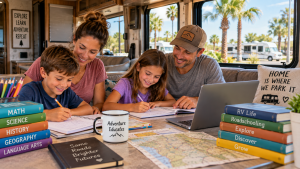
August hits full-time RV families with kids a little differently than it hits everyone else. There’s no first-day-of-school photo on a driveway, no backpack shopping trip to a specific store you’ve been going to since kindergarten — but there’s still a real shift in rhythm the whole family feels, and Mission happens to be a genuinely good place to lean into that shift for the month.
Why August Still Matters Even Without a School Building
Even families who’ve built their entire education approach around the flexibility of the road tend to feel a pull toward more structure in August, for a few genuine reasons. Extended family, co-op groups, and any local community connections a family maintains often shift back into a school-year rhythm around this time, and staying loosely in sync with that broader calendar makes coordinating with grandparents, cousins, or homeschool co-op friends considerably easier than running on a completely independent schedule year-round.
There’s also a practical curriculum reality: many families using a structured curriculum, whether a formal accredited program or a self-directed one they’ve built themselves, naturally think in terms of an academic year that starts sometime in August or September, since most educational materials and grade-level benchmarks are built around that traditional calendar.
Why Settling Into Mission Works Well for a Roadschool Reset
A longer stay in one location is exactly the kind of stability that makes settling into a fresh academic routine actually workable. Rather than trying to establish new school habits while also driving to a new location every few days, a family who’s decided to slow down and stay put in Mission for a while gets the consistency that makes routine-building genuinely possible.
“The families who handle this well aren’t the ones with the most elaborate system — they’re the ones who pick a stay long enough to actually settle into a rhythm before moving on again. Trying to start a new school year while also town-hopping every four days is a recipe for nobody getting anything done. Slow down for August specifically, and the whole thing gets easier.”
Setting Up a Workable Learning Space
Even in a smaller RV, designating a specific spot — a table that becomes “school” during certain hours, a particular cushion or chair that’s the reading spot — helps kids mentally shift into learning mode, the same psychological trick a classroom does for kids in a traditional school setting. This doesn’t require a major renovation; it just requires consistency in where and when the learning happens.
Internet and Connectivity for Online Curriculum
For families using any online curriculum component, virtual co-op classes, or video-based instruction, reliable internet access becomes a genuine daily-life necessity rather than a nice-to-have. Confirming your RV site’s Wi-Fi capability, or having a solid cellular hotspot backup plan, before committing to a longer academic-focused stay avoids the frustration of unreliable connectivity interrupting a curriculum that depends on it.
Understanding Texas Homeschool Requirements
One genuinely important piece for families settling in Texas specifically for the school year: Texas treats homeschools as a category of private school rather than regulating them through a separate homeschool statute. This comes from Texas Education Code Section 25.086(a)(1), and was confirmed by the Texas Supreme Court in Leeper v. Arlington I.S.D. back in 1994. In practice, this means Texas doesn’t require formal notification to enroll, doesn’t dictate a specific curriculum, and doesn’t set minimum instructional hours — but families are still expected to use a genuine, “bona fide” written curriculum covering five core subjects: reading, spelling, grammar, math, and good citizenship.
This is one of the more permissive homeschool environments in the country, but “permissive” doesn’t mean “no requirements at all.” If your family’s legal domicile is a different state, though, Texas’s rules don’t automatically apply to you just because you’re physically staying here — your actual requirements follow your domicile state, which is exactly why checking directly with an organization like the Home School Legal Defense Association for your specific state’s current rules is worth doing rather than assuming Texas’s relatively relaxed approach applies to your situation.
Turning the Rio Grande Valley Into Genuine Curriculum
One of the specific advantages of roadschooling is turning the local area itself into curriculum material rather than treating location as incidental to the “real” schoolwork. Mission and the broader Rio Grande Valley sit along a genuine ecological crossroads — the Santa Ana National Wildlife Refuge, part of the U.S. Fish and Wildlife Service’s system, protects one of the most biologically diverse pockets in the country specifically because the Valley sits where temperate and subtropical species ranges overlap. That’s not just a fun fact for a nature walk — it’s a genuine, hands-on biology and ecology lesson that a textbook alone can’t replicate.
Building Field Trips Into Your School Day
A morning at a local butterfly garden or wildlife refuge becomes a real biology lesson in species range and habitat. The Valley’s own agricultural history and border geography give genuine material for history, geography, and even economics lessons about trade and cross-border agriculture. Treating these outings as legitimate curriculum time, rather than something separate from “real” school, is exactly the philosophy that makes roadschooling genuinely effective rather than just homeschooling with better scenery.
For families looking for specific activities to keep kids engaged between school sessions, the how to keep kids entertained at Mission RV Resort guide covers practical ideas that pair naturally with a roadschooling schedule, giving structure to the downtime between lessons.
Building a Simple Weekly Rhythm
A practical structure that works well for a longer Mission stay: core academic subjects in the morning while energy and focus are highest and before the day’s heat sets in, a midday break during the hottest hours, and an afternoon built around a specific regional field trip or lighter project work a couple of times a week. This gives structure without rigidity and takes real advantage of what the Valley specifically offers rather than treating Mission as just a backdrop for schoolwork that could happen anywhere.
For families planning the broader logistics of an extended Valley stay around this kind of roadschooling rhythm, the ultimate guide to RVing in Mission and the Rio Grande Valley covers the wider regional context worth understanding as you settle in for the month.
Why August still matters: staying loosely in sync with the traditional school calendar helps coordinate with extended family, co-ops, and curriculum materials built around an academic year.
Settling in helps: a longer stay makes establishing a real routine far easier than trying to start fresh while relocating frequently.
Texas homeschool law: homeschools are legally private schools (Texas Education Code 25.086(a)(1), confirmed in Leeper v. Arlington I.S.D.) — no formal notification or state-approved curriculum required, but instruction must be bona fide and cover five core subjects.
Domicile matters: if Texas isn’t your family’s actual legal domicile, these rules don’t automatically apply to you — confirm your real domicile state’s requirements with HSLDA.
Turn the Valley into curriculum: Santa Ana National Wildlife Refuge and similar sites offer real biology/ecology lessons tied to the Valley’s unique subtropical-temperate overlap.
Weekly rhythm: core academics in the morning before heat sets in, midday break, field trips or lighter work a couple times a week.
For families planning an extended Mission stay built around a genuine roadschooling routine, Mission RV Resort is the starting point for finding a site that supports the kind of settled, consistent stay this approach benefits from, and the Mission RV Resort photo gallery gives a sense of the property itself.
Frequently Asked Questions
How do full-time RV families handle back-to-school without a fixed school?
Most full-time RVing families with kids use homeschooling or roadschooling — an approach that incorporates travel and hands-on, location-based learning alongside more traditional academic work. Even without a physical school building, many families still treat August as a meaningful reset point, since curriculum materials, extended family schedules, and homeschool co-op groups often follow the traditional academic-year calendar. Settling into a longer stay at one location during this period tends to make establishing a fresh routine considerably easier.
What are the homeschool requirements for a family staying in Texas?
Texas treats homeschools as a category of private school under Texas Education Code Section 25.086(a)(1), confirmed by the Texas Supreme Court in Leeper v. Arlington I.S.D. in 1994. This means no formal state notification is required, and the state doesn’t dictate specific curriculum or minimum instructional hours, but families must use a genuine, bona fide written curriculum covering five core subjects: reading, spelling, grammar, math, and good citizenship. If your family’s legal domicile is a different state, though, that state’s requirements apply to you instead, regardless of where you’re physically staying.
How can I turn the Rio Grande Valley into a roadschooling curriculum?
The Valley offers genuine, hands-on curriculum material through its unique ecology and geography — sites like the Santa Ana National Wildlife Refuge sit at a crossroads where temperate and subtropical species ranges overlap, giving real biology and ecology lessons a textbook can’t replicate. The region’s agricultural history and border geography also provide authentic material for history, geography, and economics lessons. Treating these outings as legitimate school time rather than separate from “real” academics is central to an effective roadschooling approach.
Is reliable internet important for RV homeschooling?
Yes, particularly for families using any online curriculum component, virtual classes, or video-based instruction, where reliable internet becomes a genuine daily necessity. Confirming an RV site’s Wi-Fi capability, or having a solid cellular hotspot as backup, before committing to a longer academic-focused stay helps avoid connectivity interruptions during instructional time.
What is roadschooling and how is it different from homeschooling?
Roadschooling is a term used within the full-time RV community to describe education that incorporates travel and location-based, hands-on learning experiences alongside more traditional academic instruction. It’s often considered a specific style or approach within the broader category of homeschooling, emphasizing real-world learning opportunities from the places a family visits combined with structured academic work in core subjects.
What is a good weekly schedule structure for roadschooling in Mission during August?
A practical structure involves core academic subjects in the morning while energy and focus are highest and before the day’s heat sets in, a midday break during the hottest hours, and an afternoon built around a specific regional field trip or lighter project work a couple of times a week. This gives structure without rigidity and takes real advantage of what the Valley specifically offers rather than treating the location as incidental to the schoolwork itself.