
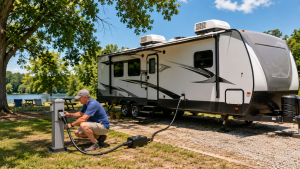
July in the Rio Grande Valley puts genuine, sustained stress on an RV’s electrical system — air conditioning units running nearly continuously, campground infrastructure under heavy collective demand from every rig doing the same thing, and heat itself degrading electrical components faster than mild weather does. Understanding how to size your AC use appropriately, protect your system from power quality issues, and manage the electrical side of a South Texas summer is the difference between a comfortable stay and a season of recurring problems.
AC Sizing: Making Sure Your System Actually Matches Your Rig
The first electrical question worth understanding is whether your RV’s air conditioning capacity is actually adequate for the conditions you’re running it in. RV air conditioners are rated in BTUs (British Thermal Units per hour), and the general guideline most manufacturers and RV technicians use is roughly 15,000 BTU of cooling capacity per 13 to 16 feet of RV length in typical climate conditions — though genuinely hot climates like South Texas in July often benefit from capacity at the higher end of that range or supplemental cooling.
Single Unit vs. Dual Unit Setups
Smaller travel trailers and truck campers commonly run a single 13,500 or 15,000 BTU rooftop unit, which is adequate for the RV’s square footage under moderate conditions but can struggle to maintain a comfortable interior temperature during sustained 95-plus degree afternoons without help from shade, window coverings, and other heat-load reduction strategies. Larger fifth wheels and Class A motorhomes frequently run two rooftop units — often a 13,500 BTU unit paired with a 15,000 BTU unit, or two matched 15,000 BTU units — specifically because a single unit’s capacity, even a large one, generally can’t adequately cool a 35-plus foot rig’s full interior volume during genuine South Texas summer conditions.
If you’re finding that your AC runs constantly without ever quite catching up to your thermostat setting during peak summer afternoons, that’s a meaningful signal that your cooling capacity may be undersized for your rig and your climate, rather than a sign that something is broken. Reducing heat load through shade and reflective window coverings helps regardless, but at some point an undersized system simply can’t overcome the combination of RV size and Rio Grande Valley summer heat without supplemental capacity.
The 50-Amp Question
Running two AC units simultaneously at full capacity requires 50-amp electrical service in almost all cases — a 30-amp connection (3,600 watts at 120 volts) typically can’t support two rooftop AC units running together along with your rig’s other standard electrical loads, while a 50-amp connection (12,000 watts at 240 volts) generally can. If your rig has two AC units, confirming 50-amp availability at your site before booking, and requesting it specifically rather than assuming any “full hookup” description includes it, is essential rather than optional for a comfortable Valley summer stay.
“The number one AC complaint we hear in July is almost never actually about the AC unit itself being broken — it’s a rig that’s either running an undersized system for its square footage, or a two-unit rig stuck on a 30-amp site trying to run both units and constantly tripping the breaker. Both of those are solvable before you ever plug in, not problems to discover after arrival.”
Surge Protection: The Non-Negotiable Summer Investment
Summer is specifically the season when RV surge protectors earn their cost many times over, and understanding why requires understanding what’s actually happening to campground electrical infrastructure during peak summer demand.
Why Summer Specifically Increases Surge Risk
When every site at a campground is running one or two AC units simultaneously during a South Texas July, the collective electrical demand on the park’s infrastructure is at its annual peak. This heavy, sustained load increases the likelihood of voltage fluctuations, brownouts (voltage drops below normal), and surges (voltage spikes, sometimes caused by equipment cycling on and off across the park, sometimes caused by grid-level events including lightning strikes on the broader electrical grid during summer thunderstorm activity). Any of these power quality issues can damage sensitive RV electronics — including your AC unit’s control board, your refrigerator, and other appliances — if your rig’s electrical system takes the full force of the anomaly directly.
What a Surge Protector Actually Does
A quality RV surge protector sits between your shore power connection and your rig, monitoring for voltage anomalies and either clamping down excess voltage during a surge or, in the case of a more advanced Electrical Management System (EMS), cutting power to your rig entirely if it detects a dangerous condition like severe undervoltage, overvoltage, or incorrect wiring at the pedestal. This is meaningfully more protection than a basic surge protector alone provides — an EMS unit actively monitors ongoing conditions rather than just clamping a single spike event, which matters specifically during a season when campground electrical infrastructure is under sustained rather than momentary stress.
For a summer RV stay, particularly an extended one, the investment in a full EMS-style surge protector rather than a basic plug-in surge suppressor is genuinely worth the additional cost, given both the increased frequency of power quality issues during peak summer demand and the higher value of the electronics (AC units, especially) that a bad power event can damage.
Hot-Weather Electrical Safety Beyond Surge Protection
A few additional practices specifically matter during sustained summer heat and heavy electrical use. Inspect your shore power cord and the campground pedestal connection periodically during an extended stay — a loose or corroded connection carrying heavy continuous AC load generates heat at the connection point, and in worst cases, this can become a fire risk. A connection that feels warm to the touch (after checking that power is appropriately isolated, or simply noting warmth near the connection without touching live components) is worth having inspected rather than ignored.
Avoid daisy-chaining extension cords or using undersized extension cords for any additional power needs beyond your primary shore power connection — undersized cords carrying AC-level current loads can overheat, and this risk is elevated during summer when you’re more likely to be running additional cooling fans, refrigeration, or other equipment beyond the baseline. If you need an extension cord for any purpose at your site, use one rated for the actual current you’ll be drawing through it, not just whatever’s on hand.
Reducing Electrical Load: The Complementary Strategy
Everything covered so far is about managing and protecting your electrical system’s capacity, but reducing the actual heat load your AC needs to overcome is the complementary strategy that makes all of the above work better. Reflective window coverings, an awning deployed on the sun-facing side, and minimizing heat-generating activity inside the rig (cooking with the oven or stovetop, running a hair dryer) during peak afternoon hours all reduce the total cooling burden, which in turn reduces electrical strain and makes both an appropriately-sized system and a marginal one perform better.
Pre-cooling your rig in the morning — opening windows while the air is still relatively cool, then closing up and running AC starting mid-morning before the day’s heat has fully built — is a specific practice that reduces the total electrical demand your system faces throughout the day, since maintaining a cool interior against a moderate starting temperature is meaningfully less electrical work than pulling a hot interior down to a comfortable temperature from scratch.
AC sizing: roughly 15,000 BTU per 13-16 ft of RV in moderate climates; South Texas summer often benefits from the higher end of that range or dual-unit setups on larger rigs.
Two AC units: requires 50-amp service (12,000W/240V) in nearly all cases. Confirm and request specifically when booking, don’t assume “full hookup” includes it.
Surge protection: summer is peak risk season due to sustained high park-wide electrical demand. An EMS-style protector (active monitoring, auto-shutoff on dangerous conditions) is worth the upgrade over a basic surge suppressor for extended summer stays.
Connection safety: periodically check shore power cord and pedestal connection for heat/looseness during extended stays. Never daisy-chain or use undersized extension cords for AC-level loads.
Load reduction: reflective window coverings, awning use, pre-cooling in the morning, and avoiding heat-generating appliance use during peak afternoon hours all reduce electrical strain on your system.
For guests planning a summer Mission stay who want the broader picture of managing South Texas heat beyond just the electrical side, the South Texas and Valley RVing guide covers the full seasonal context. The year-round Valley lifestyle guide gives the longer-term picture for extended or seasonal stays where electrical system reliability matters even more. The McAllen area guide covers activities and amenities for days when you want a break from the RV entirely. Visitors approaching from the Sullivan City corridor to the west can check the Sullivan City RV park page. And for booking a summer stay at Mission RV Resort with proper hookup service confirmed, Mission RV Resort is the starting point.
Frequently Asked Questions
How many BTUs of AC do I need for my RV in South Texas summer?
A general guideline is approximately 15,000 BTU of cooling capacity per 13 to 16 feet of RV length under moderate climate conditions, but genuinely hot climates like the Rio Grande Valley in July often benefit from capacity at the higher end of that range, or from supplemental cooling strategies alongside a standard-sized unit. Larger fifth wheels and Class A motorhomes commonly run two rooftop AC units (such as a 13,500 BTU unit paired with a 15,000 BTU unit) specifically because a single unit, even a large one, often can’t adequately cool a 35-plus foot rig’s interior during sustained South Texas summer heat. If your AC runs constantly without maintaining your thermostat setting during peak afternoons, this may indicate your system is undersized for your rig and climate rather than a malfunction.
Do I need 50-amp service to run two RV air conditioners?
Yes, in nearly all cases. A 30-amp connection provides 3,600 watts at 120 volts, which typically cannot support two rooftop AC units running simultaneously along with your rig’s other standard electrical loads. A 50-amp connection provides 12,000 watts at 240 volts — more than three times the capacity — which generally can support two AC units running at full capacity together. If your rig has two AC units, confirming 50-amp availability and requesting it specifically when booking a summer site, rather than assuming any general “full hookup” listing includes it, is essential for reliable dual-unit operation.
Why is summer a higher-risk time for RV electrical surges?
During peak summer heat, campground electrical infrastructure experiences its highest annual collective demand, since most or all sites are running one or two AC units simultaneously. This heavy, sustained load increases the likelihood of voltage fluctuations, brownouts, and surges — sometimes caused by equipment cycling across the park, sometimes by grid-level events including lightning strikes during summer thunderstorm activity. Any of these power quality issues can damage sensitive RV electronics, including AC control boards and other appliances, if a rig’s electrical system takes the full impact directly without protection. This elevated summer risk is why surge protection is specifically emphasized as a hot-weather electrical priority.
What is the difference between a basic surge protector and an EMS for an RV?
A basic RV surge protector clamps down excess voltage during a surge event, providing protection against that specific type of power quality issue. An Electrical Management System (EMS) provides more comprehensive protection by actively monitoring ongoing electrical conditions and automatically cutting power to the rig if it detects dangerous conditions such as severe undervoltage, overvoltage, or incorrect wiring at the pedestal — not just a single spike event. For extended summer stays, when campground electrical infrastructure is under sustained rather than momentary stress, an EMS-style protector generally provides meaningfully better protection for the investment compared to a basic plug-in surge suppressor alone.
How can I reduce electrical strain on my RV’s AC system in summer?
Reducing the total heat load your AC system needs to overcome makes both properly-sized and marginal systems perform better. Reflective window coverings, deploying your awning on the sun-facing side, and avoiding heat-generating activities like oven or stovetop cooking during peak afternoon hours all reduce the cooling burden on your system. Pre-cooling your rig in the morning — opening windows while the air is still cool, then closing up and running AC starting mid-morning before peak heat builds — reduces total daily electrical demand, since maintaining a moderately cool interior requires meaningfully less electrical work than cooling down an already-hot interior from scratch later in the day.
What should I check on my RV’s electrical connections during a long summer stay?
During an extended summer stay with heavy, continuous AC usage, periodically inspecting your shore power cord and the campground pedestal connection for looseness or heat buildup is a worthwhile safety practice — a loose or corroded connection carrying heavy continuous load generates heat at the connection point, which in worst cases can become a fire risk. Additionally, avoid daisy-chaining extension cords or using undersized extension cords for any additional power needs, since undersized cords carrying AC-level current loads can overheat, a risk that’s elevated in summer when additional cooling fans or refrigeration equipment beyond baseline usage are more common.